Nations League
Nations League 2026/27: Spectacular climax, surprising results and eight nations still dreaming of the title
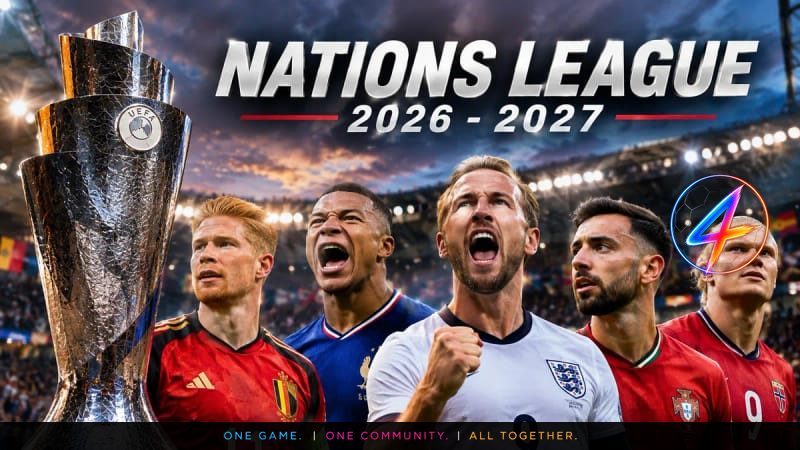
Belgium rises against Italy, England breaks a Spanish record run, Germany humiliates the Netherlands and Haaland writes a new chapter in Norwegian football history in the dying seconds.
18 November 2026 | International football
Sometimes football needs ninety minutes to tell a story. Sometimes a single moment is enough.
A penalty deep in stoppage time. A goalkeeper who saves a spot‑kick when his side seems to have nothing left to play for. A European powerhouse that gets hit for five goals. Or a national team that looks down a deficit after eleven minutes and, an hour later, celebrates a win that saves its season.
The group stage of the UEFA Nations League 2026/27 had it all.
Between 24 September and 17 November the European national sides fought not only for points but also for prestige, promotion and a place among the eight remaining candidates for the final prize. Some favourites confirmed their reputation. Others discovered how thin the line between triumph and humiliation can be.
And while France, Germany, England and Portugal won their groups, Belgium, the Netherlands, Spain and Norway wrote their own stories to reach the quarter‑finals.
Eight nations can still dream of the trophy. For eight other top‑division participants the battle for the final prize ends here.
But the most striking thing about this Nations League may not be who advances.
It is the way it happens.
Belgium: from the brink of elimination to an unforgettable night
There are matches that bring a win. And there are matches that restore belief to a national side.
For Belgium the home game against Italy was such a night.
The Red Devils started their final group match in third place. France had firmly entrenched itself in the fight for the group title and Italy sat between Belgium and a quarter‑final spot.
The task was clear, but no less demanding.
When Francesco Pio Esposito gave Italy the lead after just eleven minutes, the scenario looked particularly unpleasant. The Italians had strengthened their early advantage and Belgium had to respond against a side with enough experience and quality to defend a lead.
But Belgium’s reply was impressive.
Maxim De Cuyper levelled the score again. Nathan Ngoy turned the tide shortly after. And when Jérémy Doku slipped between the Italian defenders after 26 minutes and tucked in the 3‑1, the match was completely turned.
The Italian defence, usually one of the national team’s foundations, could not cope with Belgian speed and directness.
Kevin De Bruyne came close to a fourth, but Gianluigi Donnarumma hit the post. After the break Italy tried to get back into the game, but it was Diego Moreira who finished a Belgian counter‑attack.
It became 4‑1.
Even when Italy earned a late penalty, the Belgian night held firm. Senne Lammens denied Esposito a second goal and sealed Italy’s disappointment.
The win meant more than three points.
Belgium finished with twelve points, second behind France, and qualified for the quarter‑finals. Italy stayed on ten points and saw its European Nations League campaign end.
Under head coach Mark van Bommel, appointed in July 2026, Belgium had a mixed group stage. An away win over Italy and a convincing home victory over Turkey were sandwiched between two defeats to France, including a painful 4‑1 loss on French soil.
Yet the side stayed upright when the pressure was greatest.
There were also promising individual signs.
De Bruyne ended the group phase as Belgium’s top scorer with three goals and two assists. Charles De Ketelaere added three assists, confirming his growing importance in attack.
But Doku’s performance against Italy will be remembered most.
His goal was a showcase of individual class and also symbolised something larger: the Belgian team’s ability to break a game open when caution was no longer an option.
The Red Devils are back among the last eight.
That is no guarantee of another European triumph. It does prove that Belgium, despite difficult moments, still possesses the quality to eliminate a top nation.
France: Zidane finds the way, but not without obstacles
On the other side of Group A1 France finished exactly where it had undoubtedly wanted to be before the start: right at the top.
Thirteen points, four wins and a ticket to the quarter‑finals.
Yet that final standing does not tell the whole story.
Zinédine Zidane’s return as head coach gave the French campaign a special character. One of the biggest names in French football history was back at the helm, this time tasked with leading a national side accustomed to the highest expectations.
The start was promising.
France won its first two games against Turkey and Belgium, drew with Italy and then beat Belgium 4‑1.
Four matches without defeat.
But in Milan the French ran into their limits. Italy won 3‑1 and revived the race for the group title.
France had to respond on the final matchday against Turkey.
They did, albeit without the ease with which great champions sometimes pull matches their way.
An own goal from Emirhan Topçu opened the game. Then Eli Junior Kroupi celebrated his first goal for the French side. A late equaliser from Abdülkerim Bardakcı added tension, but France held on: 2‑1.
The French finished as group winners.
Individually, Michael Olise was the most striking attacking force. With five goals and two assists the Bayern Munich player left a clear mark on the campaign.
His performances show that France also has players beyond its established stars who can decide games.
The French have reached their first goal. But the defeat in Italy and the uneasy final match remind us that this side remains vulnerable.
Germany and the Netherlands: three days between euphoria and humiliation
If one group captures the unpredictability of the Nations League, it is Group A2.
Germany, the Netherlands and Greece all finished with eleven points.
Three nations, the same points tally and yet three very different emotions.
Germany became group winners. The Netherlands finished second. Greece lagged behind, despite a campaign that gathered as many points as both quarter‑finalists.
The difference ultimately came down to head‑to‑head results.
For the Netherlands the contrast could hardly be larger.
On 13 November Oranje enjoyed an impressive night. Greece were beaten 7‑0 and Tijjani Reijnders scored a hat‑trick.
Coach Xavi Hernández’s side seemed to send a strong signal to Europe.
Three days later the reality hit.
In Berlin the Netherlands were thrashed 5‑0 by Germany.
It was not a narrow loss decided by an unlucky own goal. Germany dominated especially after the break and turned the final match into a showcase of attacking efficiency.
Derry Scherhant opened the scoring shortly before halftime. Then Florian Wirtz took over the game.
With two goals he led the German attack, while Nico Schlotterbeck and Brajan Gruda also got on the scoresheet.
Five goals against a historic rival.
For Germany that win crowned a group phase that had started far from convincing.
Under Jürgen Klopp Germany had won only once in its first four matches. They lost to Greece and drew twice.
The doubts were understandable.
But in November two victories, over Serbia and the Netherlands, proved enough for the group win.
Wirtz finished as Germany’s top scorer with four goals. Gruda left a particularly strong impression with two goals and two assists in just two appearances.
The Netherlands, meanwhile, had to digest the heaviest defeat of their campaign.
The damage was not fatal. Thanks to the head‑to‑head results with Germany and Greece, Oranje stayed second and also secured a place among the final eight.
For Greece the disappointment was equally sharp.
The Greeks had beaten Germany 1‑0 earlier and also won their last match against Serbia thanks to a goal from Giorgos Masouras.
Eleven points proved insufficient.
That is the harshness of a competition where not only the total points count, but also performances against direct rivals.
Serbia, on the other hand, finished without a single point – a painfully poor campaign that sends the nation to the promotion‑ and relegation‑play‑offs.
For Germany and the Netherlands a new chapter begins in March.
For Greece the lingering question is how much more a national side must do to break through when eleven points are not enough.
England: a historic night in Madrid
Some victories only gain real meaning when you know what preceded them.
Spain had gone 43 matches without a loss.
An impressive run that spoke of continuity, technical quality and confidence for a national side that had long held its own among Europe’s greats.
On 15 November that streak ended in Madrid.
England won 3‑2.
Thomas Tuchel’s side opened the group phase with a defeat to the same opponent. Spain had won 2‑3 at Wembley.
But then England embarked on a five‑match winning streak.
The 7‑0 thrashing of Croatia was the most striking result, yet the win in Madrid may have been the most important.
Harry Kane opened the scoring from the penalty spot. After the break Ezri Konsa and Ben White stretched the lead to 0‑3.
England seemed to have the match fully under control.
Spain did not give up.
A foul by Elliot Anderson on Lamine Yamal left England with ten men. Mikel Oyarzabal converted the penalty and Nico Williams added a second Spanish goal to bring the tension back.
Suddenly England had to survive.
Goalkeeper James Trafford played a crucial role in the dying minutes and helped his side preserve the lead.
When the final whistle blew, not only was Spain’s unbeaten run over, England had also secured the group win.
Both England and Spain finished on fifteen points, but England topped the table.
The face of England’s campaign was once again Harry Kane.
The striker scored eight goals and finished as the top scorer of the entire group phase.
He also overtook Peter Shilton as the record‑appearance holder for the English men’s team.
Jude Bellingham was also vital. With six assists he was the best provider of the group phase.
For Spain the loss of first place is disappointing, but not a disaster.
Luis de la Fuente’s side won five of six games and remains one of the eight candidates for the final prize.
For Croatia and the Czech Republic the story was far less positive.
Croatia collected only six points and lost four games in a row before beating the Czech Republic 2‑1 on the final day.
The Czech Republic endured an even harsher campaign: six matches, six defeats and zero points.
The nation is relegated directly to Division B.
Croatia must try to retain its place at the top level via the play‑offs.
Norway: Haaland refuses to accept the end
There are moments when even the most seasoned football fan thinks they know how a match will finish.
Denmark versus Norway, 17 November 2026.
After barely fourteen minutes Denmark led 2‑0.
Rasmus Højlund opened the scoring. Pierre‑Emile Højbjerg doubled the lead.
For Norway the evening seemed set for a painful failure.
The side needed a win to qualify directly for the quarter‑finals. Denmark appeared on track for the second spot behind Portugal.
But Norway had Erling Haaland.
Before the break the striker pulled the score back to 2‑1.
It was his fifth goal of the campaign.
Denmark, however, held on for a long time.
Only in the 83rd minute did Martin Ødegaard level the game with a shot.
Two‑all.
Still not enough for Norway.
The match looked set to end with a result that would see Denmark secure a place among the last eight.
Until deep into stoppage time.
Norway earned a penalty.
Haaland took responsibility.
The forward stayed calm and scored his sixth group‑stage goal.
2‑3.
What had looked a few minutes earlier like a Danish celebration turned into a Norwegian triumph.
Norway finished with nine points, second in Group A4. Denmark also collected nine points but, because of head‑to‑head results, ended third.
For the Danes it was a particularly harsh finish.
Their 4‑1 win over Portugal a few days earlier had shown how much quality the side possessed. Yet at the decisive moment qualification slipped away.
For Norway the joy was all the greater.
Haaland delivered another six goals. Ødegaard, with five assists, was the main creator.
Together they powered a national side that refused to give up its ambitions at the very last moment.
Portugal: a new generation takes over
Portugal entered the group phase as defending champions.
The country won the Nations League in 2019 and 2025 and now knows what it takes to lift the trophy again.
Yet the Portuguese campaign was also about change.
Jorge Jesus arrived as the new head coach. In November the international farewell of Cristiano Ronaldo also took place.
A historic era therefore came to an end.
But Portugal kept winning.
The first four group matches were all victories. The side secured a place in the quarter‑finals early.
The 1‑4 home loss to Denmark then served as an unexpected warning.
Portugal proved not invincible.
In the final match against Wales a fitting answer followed.
In Cardiff Portugal took the lead through Bruno Fernandes, but David Brooks quickly equalised. Sorba Thomas then put the home side ahead 2‑1.
Pedro Neto added a late equaliser.
In the second half Carlos Forbs restored the lead for Portugal.
Even a late red card for Neto could not prevent the win.
Portugal won 3‑2 and closed the group phase with fifteen points.
Gonçalo Ramos and João Félix, each with three goals, were the team’s top finishers.
The squad has shown it can score and win without Ronaldo.
That does not mean his historic impact can be easily replaced, but it does show Portugal has entered a new phase without losing its ambitions.
The stars who made the difference
A competition is ultimately decided by teams. But the memories are often shaped by players.
Harry Kane, with eight goals, was the most prolific finisher of the group phase. The English captain combined his tally with a historic milestone as record‑appearance holder.
Erling Haaland netted six times and again proved his exceptional ability to be decisive when pressure peaks. His late penalty against Denmark belongs among the most memorable moments of this group stage.
Michael Olise, with five goals and two assists, was a key factor in France’s success.
Florian Wirtz helped Germany get back on track after a shaky start. His two goals against the Netherlands will be remembered for a long time.
Tijjani Reijnders enjoyed an individual top night with his hat‑trick against Greece, only to experience three days later how quickly sentiment can swing in international football.
Jude Bellingham led the assist chart with six, while Martin Ødegaard contributed five and also had a direct hand in Norway’s decisive win.
Outside Division A there were also outstanding performances.
Viktor Gyökeres, with Sweden, put together an impressive run by scoring in eight consecutive Nations League matches. No ninth match was added in the final group game against Poland.
In Ireland, Troy Parrott grew into an important figure. The striker converted two penalties against Kosovo and finished with six goals.
These achievements show that the Nations League is now much more than a collection of international friendlies.
Individual class can directly decide promotion, qualification or elimination.
Among the European elite: promotions, surprises and new ambitions
While most attention focused on the battle among Europe’s biggest football nations, equally important matches were played in the lower divisions.
For some national sides there was no quarter‑final at stake, but the chance to join the European elite.
Switzerland achieved that convincingly.
With sixteen points it won its group in Division B. A 4‑0 victory over Scotland on the final matchday underscored the gap between the two teams.
Slovenia finished second and can try to promote to Division A via the play‑offs.
In Group B2 Northern Ireland wrote a special story.
The side held Hungary to a 1‑1 draw in Budapest and secured the group win and direct promotion to the top tier.
A crucial result for a national team that does not have the same deep player pool as many established European powers.
Austria also earned direct promotion.
In Group B3 it finished first with twelve points.
Ireland sealed a convincing final‑day win by beating Kosovo 3‑0. Parrott, again with two converted penalties, was decisive.
That victory gave Ireland second place and a chance to promote to Division A through the play‑offs.
Sweden won the fourth group of Division B.
With fourteen points it stayed ahead of Bosnia and Herzegovina. Sweden returns directly to the top level, while Bosnia must go through the play‑offs.
For the runners‑up the dream lives on.
Slovenia, Hungary, Ireland and Bosnia and Herzegovina will have a chance in March 2027 to join the sixteen strongest Nations League nations.
For North Macedonia, Georgia, Israel and Romania the situation is less favourable.
They finished at the bottom of their groups and must fight via the play‑offs to avoid relegation to Division C.
There too the next international window can be decisive for the future.
Division C: where progress has its own meaning
If you only look at the most famous nations, you miss a large part of the Nations League story.
For national sides that rarely reach the centre of European football, this competition offers a valuable perspective.
Promotion is not a footnote for them, but a tangible sporting achievement.
Albania won Group C1 with fifteen points.
A 2‑0 win over Belarus on the final day sealed promotion. Rei Manaj contributed a goal and an assist.
Montenegro was even more convincing in Group C2.
With sixteen points it topped the table and secured promotion to Division B.
In Group C3 Slovakia took first place, while Iceland, with fourteen points, proved the strongest side in Group C4.
For Iceland the 3‑0 victory over Luxembourg was an important confirmation.
The nation returns to Division B.
The battle for second places also produced notable stories.
The Faroe Islands drew all five of their group matches.
Five games, five points.
On the final day they finally won: Áki Samuelsen scored the only goal against Moldova, earning a place in the promotion play‑offs.
Estonia, Cyprus and Belarus still have a chance to push through.
For these countries a place in Division B can be a significant next step.
And perhaps that is one of the Nations League’s strongest points.
The competition gives not only the giants something to play for.
It also gives smaller football nations a concrete goal.
The dark side of the competition: relegation and disappointment
Where some celebrate, others must start again.
Turkey and the Czech Republic finished the group phase in Division A without a single point.
Six matches. Six defeats.
For both nations this means direct relegation to Division B.
Turkey could not force any result in a particularly tough group with France, Belgium and Italy.
The Czech Republic suffered the same fate against England, Spain and Croatia.
The way some defeats unfolded will weigh heavily in evaluations.
Even for nations that do not drop directly, the situation remains uncertain.
Serbia, Croatia, Denmark and Wales must defend their place in the top division via the play‑offs.
For Denmark this is especially bitter.
The side seemed on its way to the quarter‑finals against Norway, only to see that chance vanish deep in stoppage time.
Croatia will look back with mixed feelings.
The 7‑0 loss to England was harsh, yet the team only managed two wins from six games.
In the top division Italy and Greece, despite finishing third, retain their places directly.
For Italy this means sporting survival but also another missed chance to win the Nations League.
For Greece the situation is different.
Collecting eleven points and still missing the quarter‑finals will be hard to swallow.
The final ranking leaves no room for debate.
In a competition where details matter, strong performances are not always enough.
The eight survivors: who can win the Nations League?
After six matchdays only one group of eight nations remains.
France, Germany, England and Portugal qualified as group winners.
Belgium, the Netherlands, Spain and Norway follow as runners‑up.
That makes the quarter‑final draw particularly interesting.
France wants to confirm its status as a European powerhouse under Zidane.
Germany hopes the impressive win over the Netherlands marks the start of a successful period under Klopp.
England has shown in Madrid that it can beat a direct rival on their own turf.
Portugal aims to defend its title and prove the new generation can continue the successes of the past.
Belgium has demonstrated it can turn a difficult starting position around.
The Netherlands wants to prove the heavy loss in Germany was not representative of its true level.
Spain will look to answer its first defeat after 43 unbeaten games with fresh top performances.
And Norway?
That nation boasts one of the world’s most dangerous strikers and has shown in Copenhagen that it only gives up when the final whistle blows.
The quarter‑final draw will take place on Friday 20 November 2026 at 12:00 CET.
The matches will be completed in March 2027. The four winners will then qualify for the final tournament in June.
Only then will it be clear which national side may crown itself Nations League champion.
A group phase that will be remembered
When the balance is taken, the numbers remain important.
England and Portugal finished with fifteen points. France won its group with thirteen. Germany needed eleven to finish top.
Belgium and the Netherlands survived in particularly competitive groups.
And Norway needed a deep‑time penalty to keep its dream alive.
But numbers never tell the full story.
They do not show what a player feels when he must take a decisive spot‑kick.
They reveal nothing about the silence that follows when a stadium realises a historic unbeaten run is over.
Or about the disappointment of a side that was minutes away from qualification only to walk away empty‑handed.
That is what football exists for.
For the tension that cannot be predicted. For the moments when a match takes an unexpected turn. For the belief that even a seemingly lost situation can change.
The Nations League has once again proved that international matches gain meaning not only through a European championship or a World Cup.
Here, reputations are built, expectations shattered and memories written.
Eight nations remain.
Eight different stories.
And one trophy.
The group phase has decided who may keep dreaming. From March 2027 it will become clear who can actually make that dream reality.